. . . Rise over run

Me and Carolyn A. go way back. Well, at least to 1999 or so, and it is actually my wife that knows her better. Jenny and Carolyn went to grade school together, and they have been friends ever since.

Carolyn and I have worked together on and off over the years — in the software field. We currently are working the same day job, and she has even been known to help with editing some of the longer pieces I put up here.

kitchen remodel Dundalk Baltimore Maryland

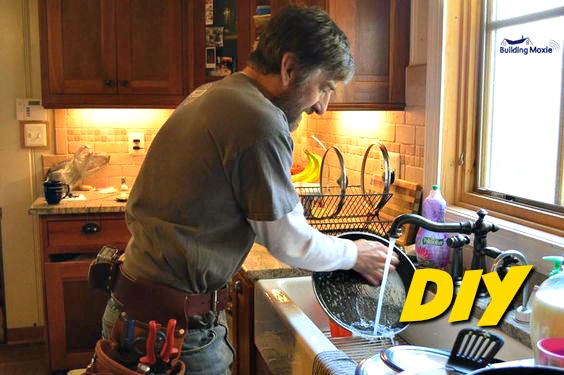
Two summers ago, I helped her with her kitchen (you should see some of these before and after pictures — wow. For now, see the picture at right — I snapped it Sunday when I was over).

That summer — I noticed the railing that ran to her upstairs was in horrible shape. You see — Carolyn is sometimes known for starting projects that she never finishes. In this case, she got the idea to strip the paint from this railing. She applied paint stripper, but got side-tracked, and never removed it. What was left was a mangled, melted mess.

. . . A penny borrowed is a penny earned (in business)

Some of you know that I have been designing a website for sometime now. Needless to say — I work part time at this venture and have money coming in, well, irregularly. So . . . when it came time for me to hire out a portion of the site design, I needed $200 and fast. I negotiated a deal with Carolyn A. where she would front me this money, and I would come over at a later date to work on said rail.

She’s good like that. And Sunday was the day, finally, that repayment was due.

Rail Refinishing — Dundalk

Let me make this clear: as a guy who lives in a 120 year-old home, and considering we have decided to save the original clapboard siding on that house — I am somewhat familiar with stripping paint.

To be honest — for this task, I have used every means conceivable, including but not limited to — chemical strippers, mechanical means such as planing and sanding, and physical means like pull scraping and wire brushing. And anyway you look at it — stripping paint is one nasty job. BUT. . . I also feel that it is something that given time is simply unavoidable. Once a layer of paint fails – you must strip.

This day, and on this rail, I go with my weapon of choice — the heat gun. And all things being equal, and considering the risk of sanding painted surfaces in a older home, it is simply the safest, cleanest and most efficient means possible at removing paint.

. . . First and second thoughts

what occurs when chemical stripper is not removed in a timely manner

When using paint stripper work in small managable sections

I hit it hard. My hope was to get the entire rail stripped clean that day. But it didn’t take me long to realize that this in fact would be quite a project. And even for me — equipped with contour scrapers and all, I adjusted my short-term projections.

I knew going in, any flat surface — no problem. And of course the rail cap, even with a detailed profile, would not be that difficult to address. It was the balusters, instead, that would be the beast. And — to complicate matters, Carolyn’s stairs have an unusually steep pitch. The result of this — steeper angles at the intersection between picket and the cap.

Again to be honest — I do not recall having encountered this baluster detail previously. And I let Carolyn know up front — yes — this rail was definitely worth saving.

At about the three-hour mark — I will admit, I wavered. This thought popped into my head: Would it have been easier to simply remove the rail and drive it out to get it “dipped?” Whew! Now that was crazy talk.

This rail, tight at the stringer, had been assembled on site (some years ago). To remove it would require disturbing the very steady newel posts, and in the end destroy quality craftsmanship. So I burn and I scrape. And I continue that way for a full eight-hour day.

Now, the shafts of the balusters were not that difficult. It was the “turns” that proved problematic. Contour scrapers were not working efficiently enough. I tried the cup of a 5-in-1 tool (you know the part for cleaning roller covers). In the end, though, I abandoned these in favor of a simple paint key . . . yes, used for opening paint cans. And it worked well, but it surely was slow going.

strip the detail in a baluster with a heat gun and a paint can key

6 hours with a heat gun and . . . a paint can opener

. . . Caution:

Heat guns, AND the heated paint they produce, are extremely hot. Burn yourself a couple times and you will learn quick enough how to work them.

I think Carolyn was happy with my progress that day. We were square. I got approximately 5/8th of the rail to a pretty good place. However, those “turns”, the fine detail on the baluster, must still be revisited. Here, chemical stripper may come in handy.

My thinking is — a box of Q-tips. I will be sure, and knowing Carolyn, to come equipped with them the next time I have to visit for debt repayment.

And . . .

As things are — I think Carolyn may agree when I say — if this paint was originally intact (i.e. not failing, flaking, pealing, etc.) it was probably better left untouched.


>> More Moxie (Related Links):

This seems like a cool site — a graphic showing handrail anatomy: http://www.scribd.com/doc/13780072/Handrail-Anatomy

Wagner Paint Tools — Heat Guns: http://www.wagnerspraytech.com/portal/heat_guns_landing_spray,43297,747.html

Lead Paint & the risks: http://www.epa.gov/lead/